
The engine is purring, the sun is shining, and you’ve just had a perfect day on the water. But then, you see it in the distance: the marina. Suddenly, your palms are sweating. You know there’s a silent audience on the docks (sometimes with beers in hand) secretly judging your every move.
Take a deep breath.
To safely dock a boat, the process is simple: 1) Prep your fenders and mooring lines long before you get close. 2) Assess the wind direction and current. 3) Approach slowly at a 30 to 45-degree angle. 4) Shift into neutral to use your momentum. 5) Use a short burst of reverse to stop dead in the water and secure the lines.
I remember one of my first attempts at Norfork Lake. Leanne was watching me from the dock with that mix of unconditional support and absolute terror as I came in straight and way too fast toward the concrete. We almost left some fiberglass behind as a souvenir. That’s when I learned the golden rule of boating: never approach the dock faster than you are willing to hit it.
Here is the step-by-step to make your arrival boring. Yes, boring. A good docking maneuver should have zero excitement and zero drama.
🛟 1. The Prep Work (Before Entering the Marina)
The worst mistake you can make is trying to hang fenders (bumpers) and untangle lines while the boat is moving toward a solid structure of wood and metal.
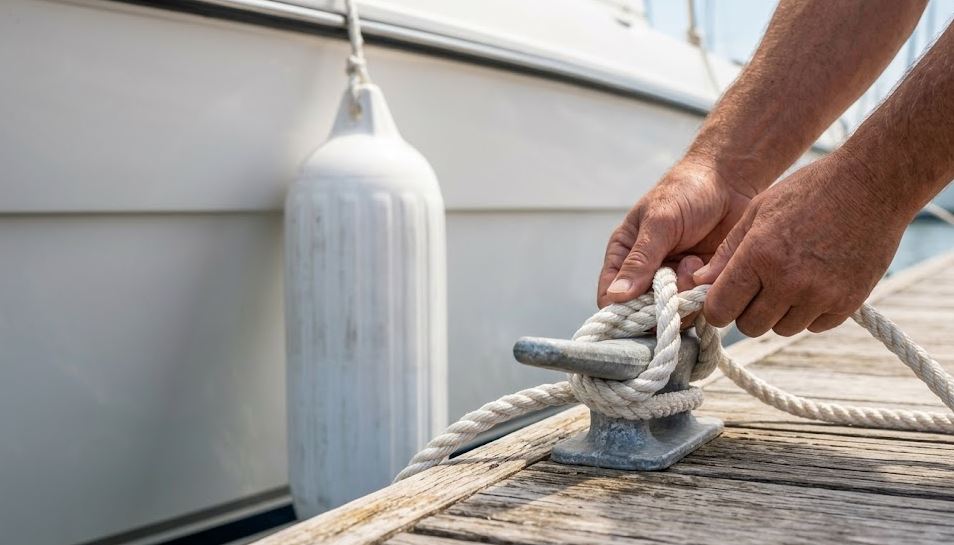
- Prep the lines: Secure one line to the bow cleat and another to the stern cleat.
- Hang the fenders: Place them on the side of the boat that will touch the dock. Adjust the height so they aren’t floating in the water, nor so high that they slide over the deck.
- Assign roles: If you have passengers, give them clear instructions. “You grab this line, do not jump onto the dock until I tell you.” Indiana Jones stunts end up in the emergency room.
🌬️ 2. Read the Elements: Wind and Current
Water doesn’t have brakes. Your boat is essentially a giant kite on an ice rink, and the wind will push your bow wherever it wants.
Before heading into your slip, pause for a moment in neutral. Look at the marina flags or how the water is moving. Where is nature pushing you?
| Situation | How to Handle It | Difficulty Level |
| Wind blowing toward the dock | Approach parallel to the dock, a few feet away, and let the wind gently push you into it. | Easy 🟢 |
| Wind blowing away from the dock | Approach at a steep angle (45 degrees). Quickly secure the bow line and use the engine to bring the stern in. | Moderate 🟡 |
| Strong opposing current | Use it to your advantage. Point the bow into the current for better steering control with the engine. | Hard 🔴 |
⚓ 3. The Approach and the Final “Kiss”
This is the best method for one simple reason: momentum control is everything. If you come in too fast and jam it into reverse, you’ll lose steering.
- The Angle of Attack: Aim for the dock at about a 30-degree angle. Think of it like diagonal parking.
- Use Neutral: Alternate between forward gear and neutral. Give the engine little bumps just to maintain steering, letting momentum do the rest.
- The Turn and Reverse: When you are a few feet from the dock, turn the steering wheel away from the dock and give it a short burst of reverse. This will stop the boat’s forward motion and gently walk the stern toward the dock.
- Secure the Lines: Fasten the line that is facing the wind or current first. Once that tension line is secured, the boat isn’t going anywhere.
💡 FAQ: Docking Your Boat
Abort the mission. Do not try to save a bad docking job by using your hands or feet to stop thousands of pounds of boat against the dock (trust me, orthopedic surgeons love people who do this). Shift into reverse, back away, and try again.
Yes. Outboards (and sterndrives) allow you to direct the thrust by turning the engine, making it easier to swing the stern in. With traditional inboards, you rely more on water flow over the rudder, which requires a bit more momentum to steer. The BoatUS Foundation has excellent diagrams if you want to dive deeper into your engine’s hydrodynamics.
Whenever there is someone on the dock. There is no shame in tossing a line to a fellow boater so they can assist you. Today you, tomorrow me.
At the end of the day, docking is 10% technique and 90% keeping your cool. At 101BoatDock, we always recommend practicing this on an empty dock on a Tuesday morning, far away from the weekend pressure.
What was your worst docking nightmare? (We all have one). Tell me in the comments!