
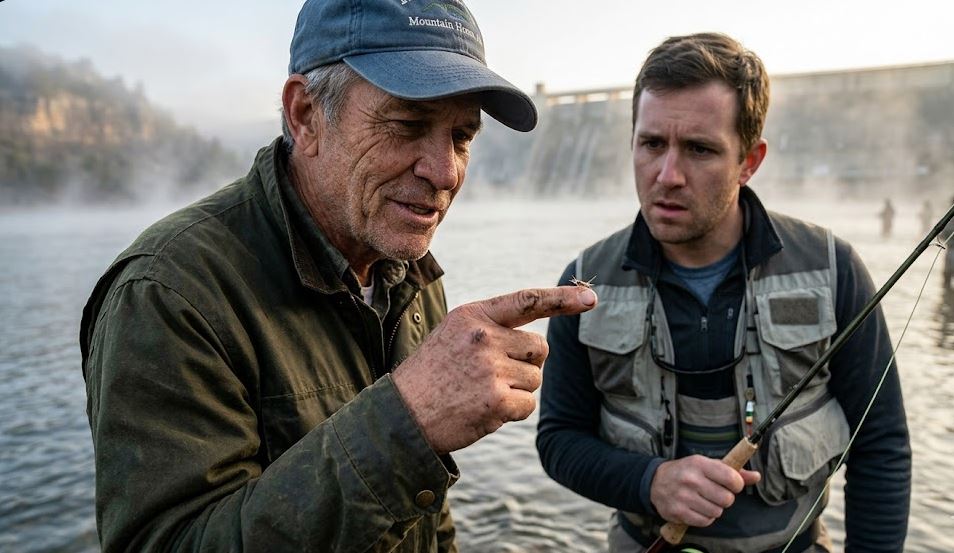
You arrive at the legendary Norfork Dam access, your first time wading these cold, clear tailwaters—known worldwide for producing monster brown trout. Everyone is speaking a code. “Hey, you hitting the caddis hat hatch?” or “Man, you got to mend that drift!”. You nod, but inside you’re thinking, is that a fish or a new sandwich in Mountain Home?
Mastering the local slang isn’t just about looking cool—it’s about understanding the complex dance of generation schedules, hatches, and why your guide just yelled, “MEND! MEND! MEND!” so loudly you thought the dam was releasing. Connecting this understanding to the current state of the river as detailed in our latest Norfork Lake Fishing Report is your first step toward sounding like a seasoned pro, not just a tourist.
Pro Tips: Having spent countless mornings guiding on the White and Norfork River Tailwaters, wading when the water is low and sprinting when the horns blast, in my experience wading these waters with clients who had absolutely zero local knowledge… I’ve seen the confusion firsthand. Take it from a local: this is the language that makes your trip.
The Funny Stuff: Guide Lingo You Only Hear Here
Guide culture is a specialized thing. We spend ten hours a day on the river, and we’ve developed a language to describe everything from a great day to a client’s epic fail. You’ll hear this stuff around Mountain Home, over a beer, or when you’re both shivering near Robinson Point.
| Slang Term | Guide-to-Local Translation | Funny Reason You Hear It | Guide Sarcasm Scale (1-10) |
| Trout Whistle | The unmistakable buzz when your fly line is perfectly taut. (Guides live for this sound.) | It sounds nothing like a whistle, but if you hear it, it means you’re on the fish. | 2 |
| Guide Fly | The fly your guide says to use. (Even if it looks like a pile of lint.) | Usually a midge so small you can’t see it. Guides use them because they work, not because they look good on Instagram. | 10 |
| The Dry Fly Hand | The desperate hand signal beginners make when they miss the only hatch of the day. | Imagine someone trying to sign ‘I just missed a fish’ with zero coordination. That’s the hand. | 8 |
| The Hookset of Guilt | When you set the hook on a rock but pretend it was a monster brown trout to save face. | Everyone does it. The guide just knows. | 7 |
| The Dry-Wade Saucery | Sarcastic term for generation starting and your client sprinting for dry land while your guide stays hip-deep. | The guide knows the exact timing. | 9 |
Essential Technical Slang for Your First Trip
Okay, the funny stuff is great, but these are the terms that keep you in the loop and prevent you from looking like—well—a “Yankee in a Guide Fly.” Mastering the drift—as described in our comprehensive Norfork Lake Map & Navigation Guide—is essential.
| Slang Term | Arkansas Tailwater Definition | Why it Matters |
| Tailwater | The river section below a dam, creating ideal (and deadly) trout conditions. | The entire river is a tailwater. Understanding flow generation is rule #1. |
| The Mend | A precise line flip to ensure your fly drifts naturally (sarcastic guides call this ‘re-casting’). | Without a mend, your fly drag looks like a small motorboat to a fish. This is the #1 skill. |
| Generation Schedule | The critical Army Corps of Engineers release schedule that dictates flow and fishing ability. | This is what defines a wade-only day vs. a ‘get the boat’ day. |
| Midge | Any tiny fly smaller than size 18, the absolute staple of Arkansas tailwater fly fishing. | Guides will put on a size 24 midge and tell you it’s ‘a big one.’ Midges catch 90% of the fish. |
| High-Sticking | Holding your rod tip extremely high to minimize line-to-water contact (great for pocket water). | Essential technique when generation is running at 1-2 units. |
5 Signs You’re Not a Local
- You don’t know the phrase “The Bull Shoals Bulge” (referencing the main White River tailwater generation).
- You try to mend upstream when the guide is begging you to mend downstream.
- You wear a full vest of gear on a wade trip where you only need three flies and a tippet.
- You ask, “What are the big flies they’re using?” (The answer is usually midges).
- You leave the Dam at 5:00 PM (locals know that’s when the real monster brown trout come out).
Local Opinion: If you are visiting and only wade-fish, you are missing 50% of the true Norfork experience. Rent a guide boat, even if it’s just for half a day. They will teach you the nuances of the flows that no book can cover.
Get Your Lingo, Then Get Your Name
So, you’ve mastered the code. You know when to mend, why your guide keeps giving you the “Guide Fly,” and that the “Dry Fly Hand” is a shameful thing to have. Your local authority is the Arkansas Game & Fish Commission Norfork Tailwater Map, which details all the access points and rules (don’t forget your license!).
The tailwater is a challenging place, but once you have the language down, maybe you’re ready for your own vessel—and an epic name from our 101 Funny Boat Names list.
I’ll be at the Dam access tomorrow, checking the release schedule. Sarcastic comments are free. Good luck with the Trout Whistle.